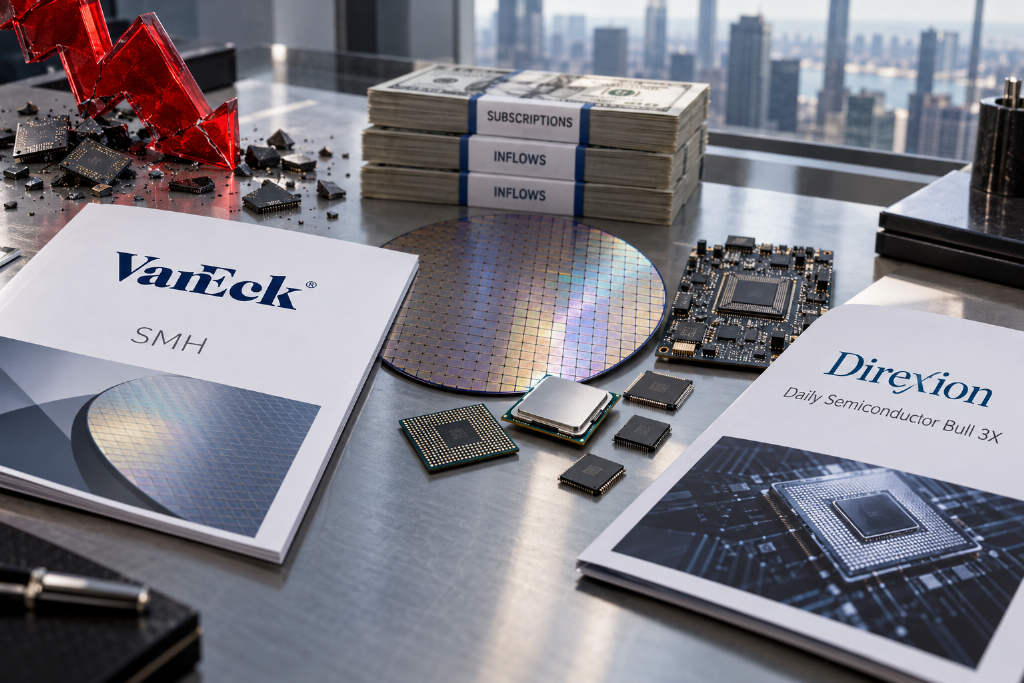
Semiconductor2026-10-15 13:25:45Semiconductor ETFs draw billions in dip-buying as chip stocks lose $1 trillion in valueInvestors poured billions of dollars into semiconductor exchange-traded funds even as chip stocks suffered a sharp sell-off that erased about $1 trillion in market value. Compiled data cited by Odaily shows that the $72 billion VanEck Semiconductor ETF pulled in more than $430 million over the past three trading sessions, putting it on track for its biggest weekly inflow since early September. Buying was even more aggressive in leveraged products. The Direxion Daily Semiconductor Bull 3X ETF, which offers triple daily exposure to the sector, brought in about $3.8 billion this week despite falling nearly 21% over the same period. For the $19 billion fund, that would be enough to mark a record weekly inflow. The backdrop remains weak: the Philadelphia Semiconductor Index has dropped 12% over the past six trading days as investors worry about artificial intelligence spending, intensifying global competition, elevated valuations and rising interest rates. Todd Sohn, chief ETF strategist at Baird Strategas, said the renewed acceleration in semiconductor stocks’ pullback has still not meaningfully curbed investor demand to buy the dip through leverage.120
Memory ETF2026-08-24 05:40:16What a Memory ETF Is: DRAM’s Holdings, Fees and Risks ExplainedArtificial intelligence demand has pushed memory stocks closer to the center of the semiconductor trade, and that has brought more attention to memory-focused exchange-traded funds. In its latest guide, ABMedia outlined how these products work and why the U.S.-listed Roundhill Memory ETF, ticker DRAM, has become one of the names most often mentioned in this niche. The report says memory ETFs target companies tied to DRAM, NAND and high-bandwidth memory, or HBM. DRAM, launched in April 2026 and listed on Cboe, is described as an actively managed ETF with roughly 23 holdings. Its portfolio is heavily concentrated in Samsung Electronics, Micron and SK hynix, which together account for about 70% based on the issuer’s recent data. The fund also uses swaps to build exposure and holds U.S. Treasuries as collateral. ABMedia also compared DRAM with broader semiconductor ETFs such as SMH and SOXX. While those funds spread exposure across the chip sector, DRAM is a much narrower bet on the memory cycle. That focus comes with a higher fee ratio of about 0.65%, versus roughly 0.35% for SMH and 0.33% for SOXX, along with greater concentration and price volatility.1410
Odaily2026-08-21 00:33:04U.S. memory chip ETF DRAM pulls in about $12 billion over the past two monthsThe Kobeissi Letter said in a post on X that the U.S. memory chip ETF DRAM has continued to attract investor money even as its market price moved sharply lower. Over the past two months, the fund’s assets under management rose 20% to a record $28 billion, while the ETF itself fell 28% during the same period. Despite that drop, DRAM still posted roughly $12 billion in net inflows and extended its streak to eight straight weeks of inflows. The post also said that since its launch on April 2, DRAM has taken in a cumulative $27 billion and its price has climbed 98% overall. In a related data point, the 2x leveraged long memory chip ETF RAM has attracted about $893 million in cumulative inflows since its debut on June 24.1270
Michael Burry2026-08-13 03:02:18Michael Burry Adds to Shorts on Nebius, Micron, Oracle, Warns AI Crash Is ComingAccording to Michael Burry Stock Tracker, 'The Big Short' investor Michael Burry has updated his positions, adding to several short bets and a couple of longs. The tracker reports that Burry added to his short position in Nebius (NBIS) at $247, in Micron (MU) at $924, in Oracle (ORCL) at $152, and in the semiconductor ETF (SOXX). On the long side, he increased his holdings in Mercado Libre (MELI) at $1,850 and Zoetis (ZTS) at $73.60. Burry was quoted as saying 「Nebius is what the top of a boom looks like.」 He also said he expects the AI boom to end in a crash. The positions were disclosed via a market tracker that monitors Burry's investments. The update shows a clear bearish tilt towards AI-related stocks, while maintaining selected long positions. Burry's latest portfolio actions reflect his stated expectation of an imminent downturn in the AI sector. The update was shared by the tracking service.1510
Policy Regula2026-08-10 02:00:00Chip selloff fails to shake risk appetite as money pours into semiconductor ETFs, junk bonds and spot Bitcoin fundsWall Street’s list of worries kept growing last week — a sharp drawdown in chip stocks, elevated Treasury yields and ongoing geopolitical tension — yet money kept moving into risk assets. The S&P 500 hit a record high and the Nasdaq 100 posted its biggest weekly gain in two months. At the same time, high-yield bond funds drew $4 billion, their strongest weekly inflow in two years, while spot Bitcoin ETFs took in $500 million over five trading days through last Thursday. The shift came after the blowup at AI-focused hedge fund Situational Awareness, founded by Leopold Aschenbrenner. The episode briefly dragged the Philadelphia Semiconductor Index 29% below its June high, but investors treated the drop as an entry point rather than a warning sign. More than $11 billion flowed into semiconductor ETFs in just two trading days, and several of those funds then rebounded sharply. Bank of America’s bull-and-bear indicator climbed to its highest level since 2021, reflecting broader optimism across equities, credit and crypto-linked products. Even with long-dated Treasury yields still near two-decade highs, market participants continued to add risk, betting that economic growth remained intact and that pullbacks would stay short-lived.2090
ETF2026-08-03 11:42:52Top three weekly ETF inflow spots go to semiconductor funds for the first timeBloomberg ETF analyst Eric Balchunas said in a post on X that the top three exchange-traded funds by weekly inflows were all semiconductor ETFs, marking the first time that has happened. He said the drop and volatility in semiconductor stocks drew traders who bought ahead of a 7% rebound. Among the products mentioned, SOXL rebounded 24%. Balchunas also noted that some traders have started taking profits, with one-day outflows already showing up. The update points to a sharp rotation into semiconductor-linked funds over the week, followed by early signs of profit-taking as prices bounced. The remarks were attributed directly to Balchunas and were posted on X, according to Odaily.2480
semiconductor2026-07-29 07:19:58Huatai-PineBridge China-Korea Semiconductor ETF posts record 25.98 billion yuan turnoverAccording to a report cited by ChainCatcher from Jinshi, the Huatai-PineBridge China-Korea Semiconductor ETF (513310) recorded another day of exceptionally heavy trading, with total turnover reaching 25.98 billion yuan. The figure set a new record for the fund and marked a 121.1% increase from the previous trading day. The ETF’s top two holdings are Samsung Electronics and SK Hynix. The update focused on the fund’s trading activity and its leading portfolio positions.2060
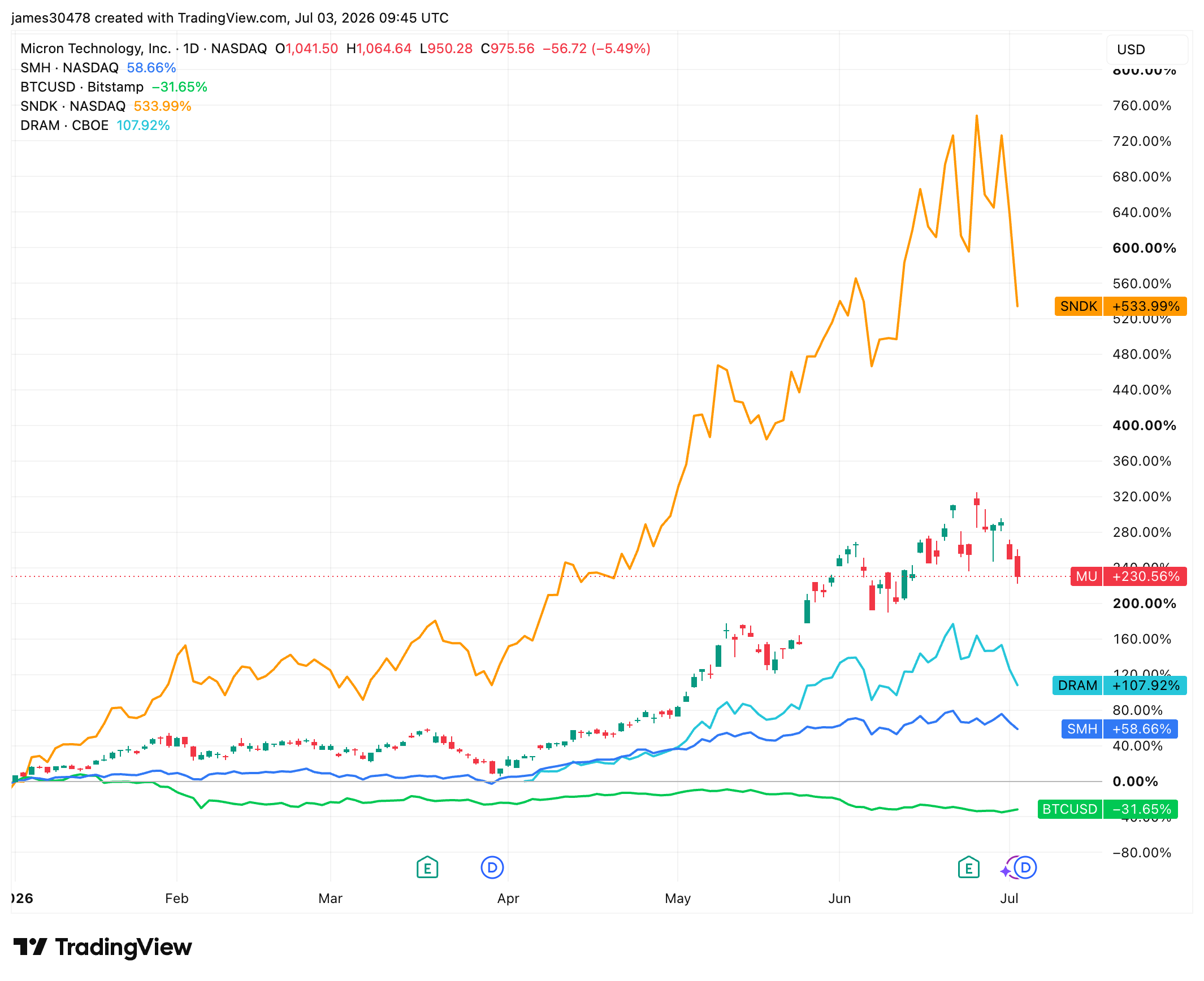
AI chip stock2026-07-24 06:30:18AI Chip Stocks Stall, Bitcoin Rebounds as Capital May Rotate into CryptoMemory and semiconductor ETFs have pulled back sharply, while Bitcoin bounces from near two-year lows, signaling a possible investor shift from AI infrastructure to digital assets.330